Vocal range test
Find your vocal range in about a minute, right on this page. Sing from your lowest note to your highest and the live meter maps your range in note names, tells you the span in octaves, and estimates your voice type. Free, no sign-up — your microphone audio never leaves your device.
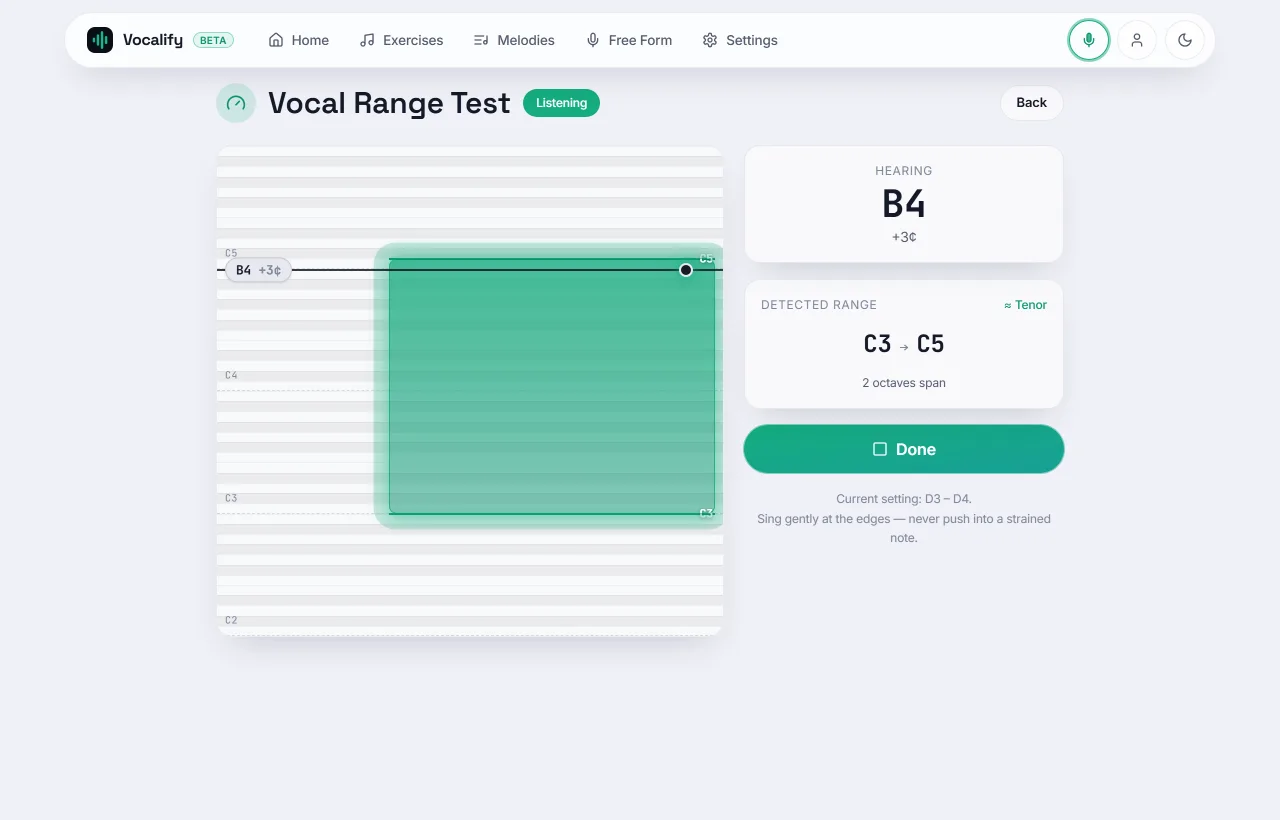
- Span
- —
- Closest voice type
- —
- Singing now
- —
Allow microphone access, then slide down to your lowest clean note and up to your highest. Nothing is uploaded.
What is a vocal range?
Your vocal range is the distance from the lowest to the highest note you can sing cleanly — not the strained squeak at the very top, but the notes that speak clearly. It's written as two note names, like C3–C5. Most untrained singers sit around 1.5–2 octaves; with gentle, consistent practice that window grows.
How to find your vocal range
- Press start above and allow microphone access — everything is analysed on your device.
- Sing down to your lowest note. Start comfortably and slide down until the tone gets breathy or disappears. The last clean note is your floor.
- Glide up to your highest. Slide up until the tone thins or strains. The last clean note is your ceiling.
- Read the result. Your range shows as note names with an estimated voice type. Run the same test inside the app to save it, so every exercise stays in your range.
Sing gently at the edges — never push into a note that hurts. A comfortable, in-tune range is more useful (and more honest) than a strained one. Re-test every few weeks to watch it widen as you train your range.
Voice types by range
Voice types are rough buckets based on where your comfortable range sits. The test estimates the nearest one — treat it as a friendly guide, since a full classification also considers tessitura (where your voice is strongest) and timbre.
| Voice type | Typical range |
|---|---|
| Bass | E2 – E4 |
| Baritone | A2 – A4 |
| Tenor | C3 – C5 |
| Alto (contralto) | F3 – F5 |
| Mezzo-soprano | A3 – A5 |
| Soprano | C4 – C6 |
Frequently asked
What is a good vocal range?
There's no magic number — comfortable, in-tune notes beat extremes. Two octaves is a healthy working range, and it grows with practice.
Can I widen my range?
Yes. Warm up, then extend a semitone at a time. See the full method in how to expand your vocal range.
Is my mic audio uploaded?
No. Pitch is detected in your browser, in real time. Nothing is sent anywhere.
Can I check my vocal range online without downloading anything?
Yes — that's the point of this page. The voice range test runs in the browser on desktop and on phones, with no app to install and no account to create. Press start, allow microphone access, sing. The other free tools work the same way.
How many octaves is my range?
Twelve semitones make an octave, so C3–C5 is exactly two. The test reports the span in semitones next to the note names, so you don't have to count intervals yourself.
Why do I get a different number every time I measure?
Because range genuinely moves. Warm-up state, time of day, hydration and a mild cold all shift the edges, and the edges are the least stable notes you own — a cold voice can measure a third short. Warm up with a few sirens and test at a similar point in the day if you want results you can compare.
Do squeaks and fry count?
No. Count only what you can hold steady and in tune for a second or two. Fry at the bottom and a strained squeak at the top inflate the number into something you can't actually sing with — and your voice type is judged on comfortable tessitura, not on your record-setting notes.
Keep the number
Run the same test in the app to save your range — then every exercise transposes to fit your voice.
Save your range in the app