How to sing in tune
Singing in tune is a motor skill built on a feedback loop: you produce a pitch, hear how far it lands from the target, and correct. Train that loop with clear, immediate feedback and accuracy improves — for almost everyone.
On this page
Why you sing flat or sharp
"Out of tune" is rarely a hearing defect. True congenital amusia — the clinical form of tone deafness — affects only around 1.5% of people[1]. Yet something like 10–15% of adults sing inaccurately, and studies of those singers find their perception is usually normal[2]. Most people who sing off-pitch can hear the error perfectly well when someone else does it; the gap is in production and in the audio-vocal feedback loop that connects what you hear to what your larynx does.
The usual culprits:
- Weak feedback. You can't yet tell, in the moment, that you're 30 cents flat — so you never correct it.
- Inconsistent breath support. Airflow that sags mid-note drags the pitch down; a push spikes it sharp.
- Singing outside your comfortable range. Notes near your limits are the first to drift.
- Unfamiliar intervals. Big or chromatic leaps are hard to target without a reference.
The case for visual pitch feedback
Motor skills are learned through knowledge of results — information about the gap between what you did and what you intended[3]. For pitch, that gap is normally invisible: by the time a teacher says "a little flat," the note is gone. Real-time visual feedback closes the loop instantly. Reviews of computer-assisted singing training conclude that seeing your pitch against a target can accelerate the acquisition of accurate intonation, especially for beginners[5].
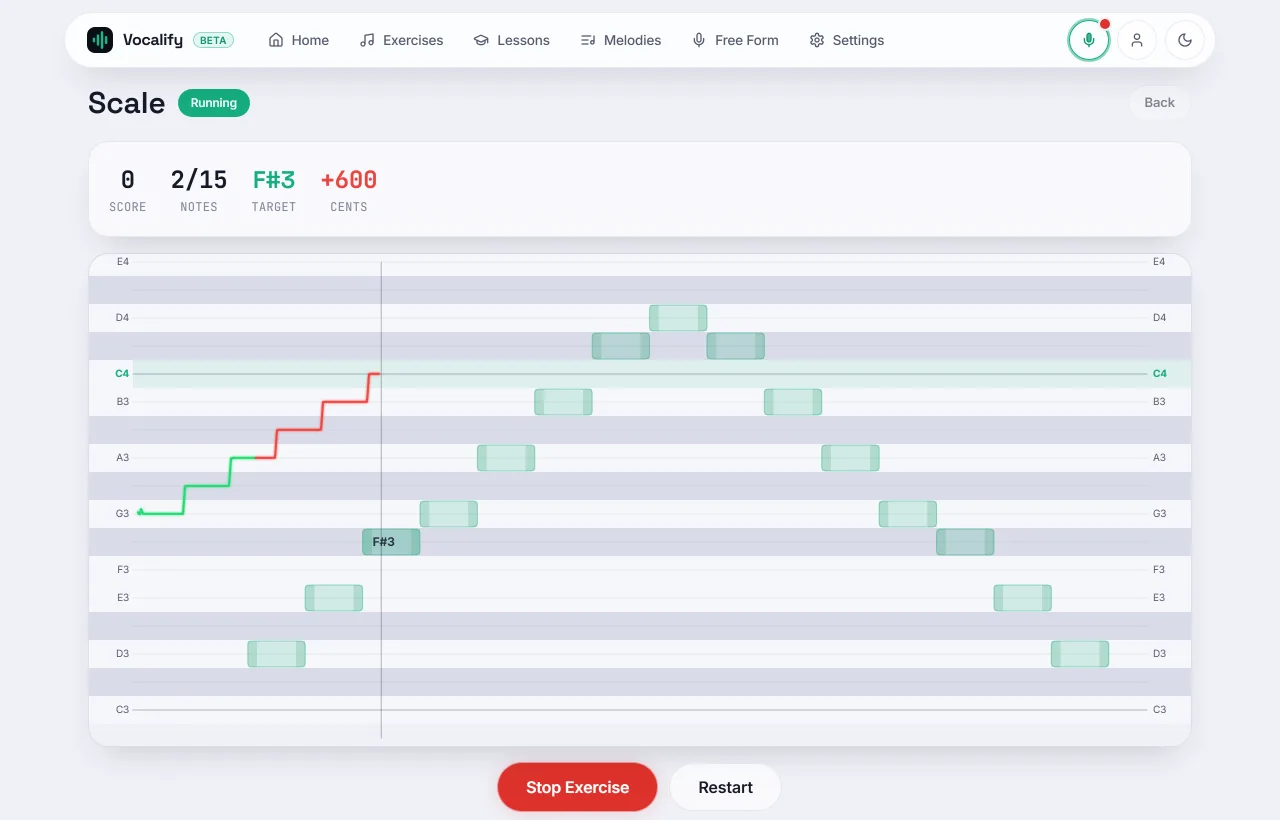
A cent is 1/100 of a semitone. Trained listeners notice deviations of roughly 20–25 cents, and unison singing that drifts past that starts to sound "off." Grading in cents — rather than a vague "good/bad" — gives you a precise error signal to chase, which is exactly the kind of feedback motor learning thrives on.
A method that works
The research points to a few principles that reliably build accuracy. Apply them in any tool, including Vocalify:
- Start where you're solid. Pick a single note in the middle of your range. Match it, hold it, and watch the line sit green before you make it harder.
- Sustain before you leap. Holding one steady pitch trains the fine laryngeal control that every interval depends on. Aim for a flat, green line, not a wobble.
- Add stepwise motion, then leaps. Move to scales — stepwise notes first, because adjacent pitches are easiest to target — then widen to thirds, fifths and the octave.
- Correct in the moment. When the line goes red, nudge toward the target while the note is still sounding. That in-the-moment correction is the rep that teaches your voice.
- Keep sessions short and frequent. Distributed practice — a little every day — beats one long weekly cram for durable motor learning[6].
Open Sing One Note to drill a sustained pitch, then move to Scales. Set your comfortable vocal range first so targets land where your voice is stable. Every run is scored so you can watch the number climb week over week.
A 10-minute daily routine
- 2 min — settle in. Easy humming or lip rolls to warm up gently before loading the voice.
- 3 min — one steady note. Hold a comfortable pitch and keep the line green and flat. Repeat on three or four different notes.
- 3 min — a slow major scale. Up and down, one note per beat, landing each note dead-center before moving on.
- 2 min — one hard interval. Pick a leap you tend to miss and rep it five times with the target in view.
Deciding which note, which scale and which interval every day is its own tax. The training plan makes that choice for you: short lessons in a fixed order, each unlocking the next once you have sung it at 70% or better.
Common mistakes
- Chasing volume, not accuracy. Loud and sharp is not "better." Keep it easy and centered.
- Practicing only songs. Songs hide your weak spots. Isolate the hard interval or note and drill it.
- Ignoring range. If a note is a strain, it will drift. Fix your range settings before blaming your ear.
- Skipping the ear. Production and perception train together — see ear training for singers.
Semi-occluded vocal tract (SOVT) work — straw phonation and lip trills, shown to improve vocal efficiency[4] — makes everything above easier, because a voice that isn't fighting itself holds pitch more steadily. Run them as sirens in the Glide exercise, or as part of a warm-up routine before you drill.
Messa di voce — a swell-and-fade on a sustained note that trains steady pitch under changing breath pressure — is still on the roadmap.
FAQ
Can anyone learn to sing in tune?
Almost everyone. With true tone deafness rare, the large majority improve markedly with focused, feedback-rich practice.
How long until I hear a difference?
Most people notice clearer, steadier pitch within a few weeks of short daily sessions. Consistency matters more than session length.
Is it too late if I'm an adult?
No. Adults retain the motor learning needed for pitch control; the feedback loop works at any age.
References
- Peretz, I., & Vuvan, D. T. (2017). Prevalence of congenital amusia. European Journal of Human Genetics, 25(5), 625–630.
- Pfordresher, P. Q., & Brown, S. (2007). Poor-pitch singing in the absence of "tone deafness". Music Perception, 25(2), 95–115.
- Salmoni, A. W., Schmidt, R. A., & Walter, C. B. (1984). Knowledge of results and motor learning: A review and critical reappraisal. Psychological Bulletin, 95(3), 355–386.
- Titze, I. R. (2006). Voice training and therapy with a semi-occluded vocal tract: Rationale and scientific underpinnings. Journal of Speech, Language, and Hearing Research, 49(2), 448–459.
- Hoppe, D., Sadakata, M., & Desain, P. (2006). Development of real-time visual feedback assistance in singing training: A review. Journal of Computer Assisted Learning, 22(4), 308–316.
- Donovan, J. J., & Radosevich, D. J. (1999). A meta-analytic review of the distribution of practice effect. Journal of Applied Psychology, 84(5), 795–805.
Try it now — sing one note
Watch your pitch land green in real time. Runs entirely in your browser.
Start the exercise