How to expand your vocal range safely
Range grows the way any physical capacity grows: warm up, load gradually, recover, repeat. Trying to bulldoze past your top note tenses the very muscles that need to move freely. The reliable path is small, consistent, well-supported steps — and a way to confirm each new note is actually in tune, not just loud.
On this page
Know your range first
You can't extend a boundary you haven't measured. Start by finding the lowest and highest notes you can produce comfortably — not the squeaky, strained extremes, but the notes that speak cleanly. That comfortable window is where practice should live, with new territory added just beyond its edges.
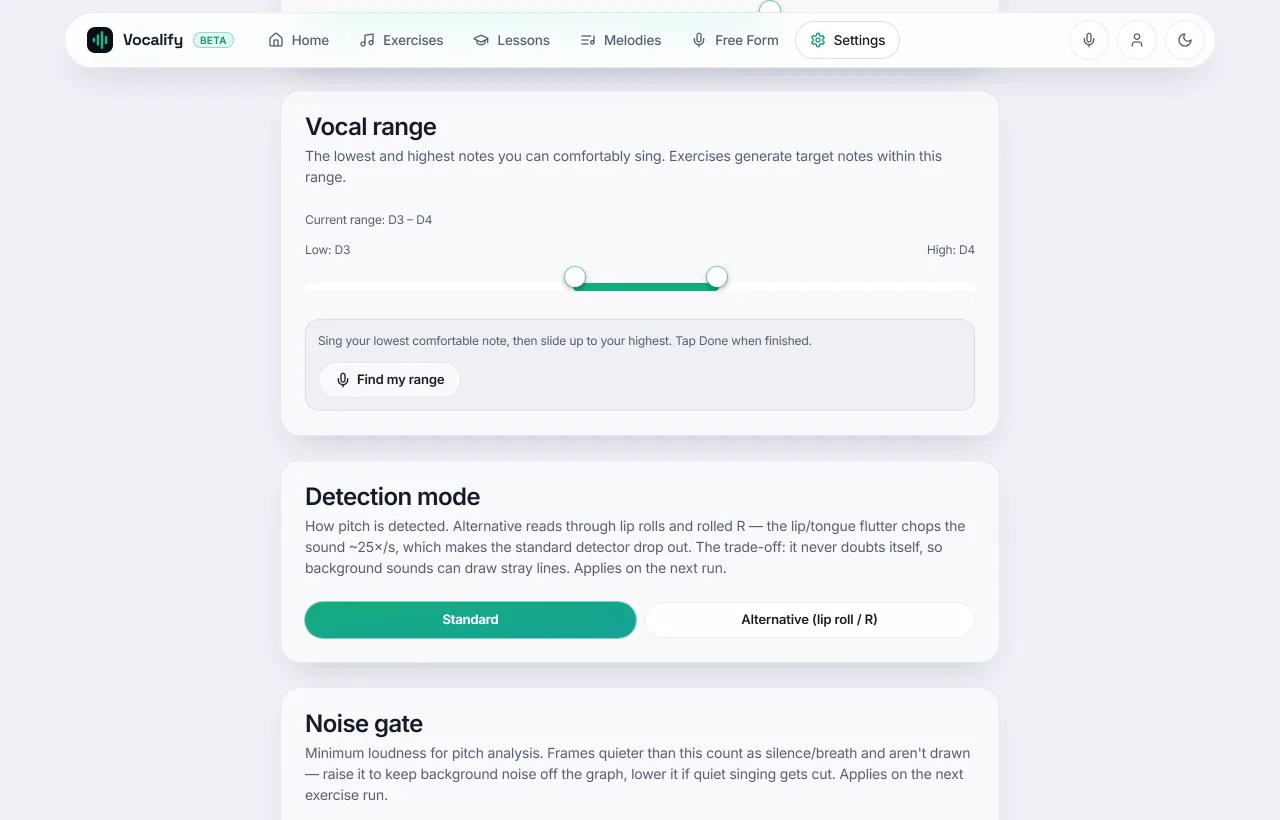
Your range setting isn't cosmetic: every exercise generates its target notes inside it, so drills stay where your voice is stable. Re-measure every few weeks — watching the window widen is one of the most motivating signals of progress.
Warm up before you reach
Warming up measurably changes how the voice behaves: studies of vocal warm-up show shifts in phonation threshold pressure and ease of production afterward[1]. In practice, a few minutes of gentle, sub-maximal sound before you attempt range work makes the extremes more accessible and less effortful. Begin in the easy middle and only then move outward.
Semi-occluded vocal tract (SOVT) exercises — humming, lip trills, and straw phonation — are a research-backed way to do this. By partly closing the vocal tract, they raise back-pressure that helps the vocal folds vibrate efficiently with less collision force, which is why they're a staple of both training and therapy[2]. A lip trill gliding gently from low to high is one of the safest ways to explore your edges.
The semitone ladder
The most dependable way to add range is to transpose a comfortable pattern up or down one semitone at a time. Sing a small five-note figure or scale where it's easy, then move it up a half step, then another — stopping the moment tone quality degrades. Over weeks, the top of the ladder creeps higher. This is progressive overload applied to the voice, and the gradualness is the point.
- Pick a pattern. A slow five-note major scale (do–re–mi–fa–sol and back) works well.
- Start easy. Sing it comfortably in your mid-range, landing every note in tune.
- Move a semitone. Transpose the whole pattern up one half step. Keep the same easy quality.
- Stop at the first strain. When tone thins, the throat grips, or pitch drifts, you've found today's edge. That's a win — don't force past it.
- Reverse for the bottom. Repeat downward to develop low notes.
Scales generate ascending and descending patterns inside your set range, and the live piano roll shows whether each new note is actually centered or just approximate. Nudge your range up a semitone as the top notes become reliable.
Support, don't push
Higher notes need steadier breath, not more muscle in the throat. Airflow that stays even lets the larynx do its job; a hard push locks it. If a note only appears when you strain, it isn't yours yet — back off a semitone and build up. Loudness and range are different goals; chasing volume at the top is the fastest route to fatigue and flat high notes.
Sirens — smooth portamento sweeps through the register transitions (the "passaggio") — are how you carry an even tone from bottom to top, and they extend range faster than scales because they never ask you to land a note you don't own yet. Vocalify's Glide exercise tracks your pitch against the moving target through the whole sweep. Sing them on a lip trill or straw (an SOVT shape) to stay efficient at the edges.
A weekly plan
- Every session — warm up first. 3–5 minutes of humming and lip-trill glides before any range work.
- 3–4 short sessions a week beat one marathon. The voice adapts with rest between loads, and distributed practice consolidates motor skills better than massed cramming[3].
- Ladder up and down a few semitones past comfort, stopping at the first sign of strain.
- Re-test your range every 2–3 weeks and update your settings.
- Rest when tired or sick. Range work on a strained voice sets you back.
When to stop
Pain, hoarseness, a tickly cough, or a voice that feels tired after singing are signals to stop for the day. Range should expand through ease, not force. Persistent hoarseness beyond a couple of weeks warrants a check with an ENT or a qualified voice teacher.
References
- Amir, O., Amir, N., & Michaeli, O. (2005). Evaluating the influence of warmup on singing voice quality using acoustic measures. Journal of Voice, 19(2), 252–260.
- Titze, I. R. (2006). Voice training and therapy with a semi-occluded vocal tract: Rationale and scientific underpinnings. Journal of Speech, Language, and Hearing Research, 49(2), 448–459.
- Donovan, J. J., & Radosevich, D. J. (1999). A meta-analytic review of the distribution of practice effect. Journal of Applied Psychology, 84(5), 795–805.
Find your range in 30 seconds
Sing low to high and let Vocalify map your span — then start laddering.
Open the range test