Vocal sirens and pitch glides
A siren is one long, smooth slide of pitch with no landing points — and that is precisely why it works. Scales let you brace for the hard note; a siren gives you nowhere to brace, so your voice has to find the seamless path across the break. Here is how to sing them, and how to see whether yours are actually smooth.
What a siren is
A siren is one continuous slide of pitch — up, down, or up-and-back — sung without ever stopping the sound. No separate notes, no landing points, just a smooth sweep like an ambulance passing. Musicians also call it a glide or portamento.
That "no landing points" part is the whole trick. Scales ask you to hit a series of discrete targets, so when your voice reaches an awkward spot, you can brace for it — tightening the throat, jumping registers, or forcing the note. A siren gives you nowhere to brace. The pitch is always moving, so your voice has to find the continuous middle ground between chest and head, and it has to find it while relaxed. That is why sirens are the standard prescription for a register break.
Why sirens work so well
- They cross the passaggio without a seam. Because there is no discrete note to arrive at, there is no moment to flip. Repeated smooth crossings teach the coordination that mixed voice depends on.
- They extend range at the edges safely. A siren approaches your top note already in motion and leaves immediately — far less loading than sitting on that note and holding it.
- They warm up efficiently. Sung on a lip trill or straw (an SOVT shape), a siren raises back-pressure that helps the folds vibrate with less collision force[1], which is why they open almost every good warm-up.
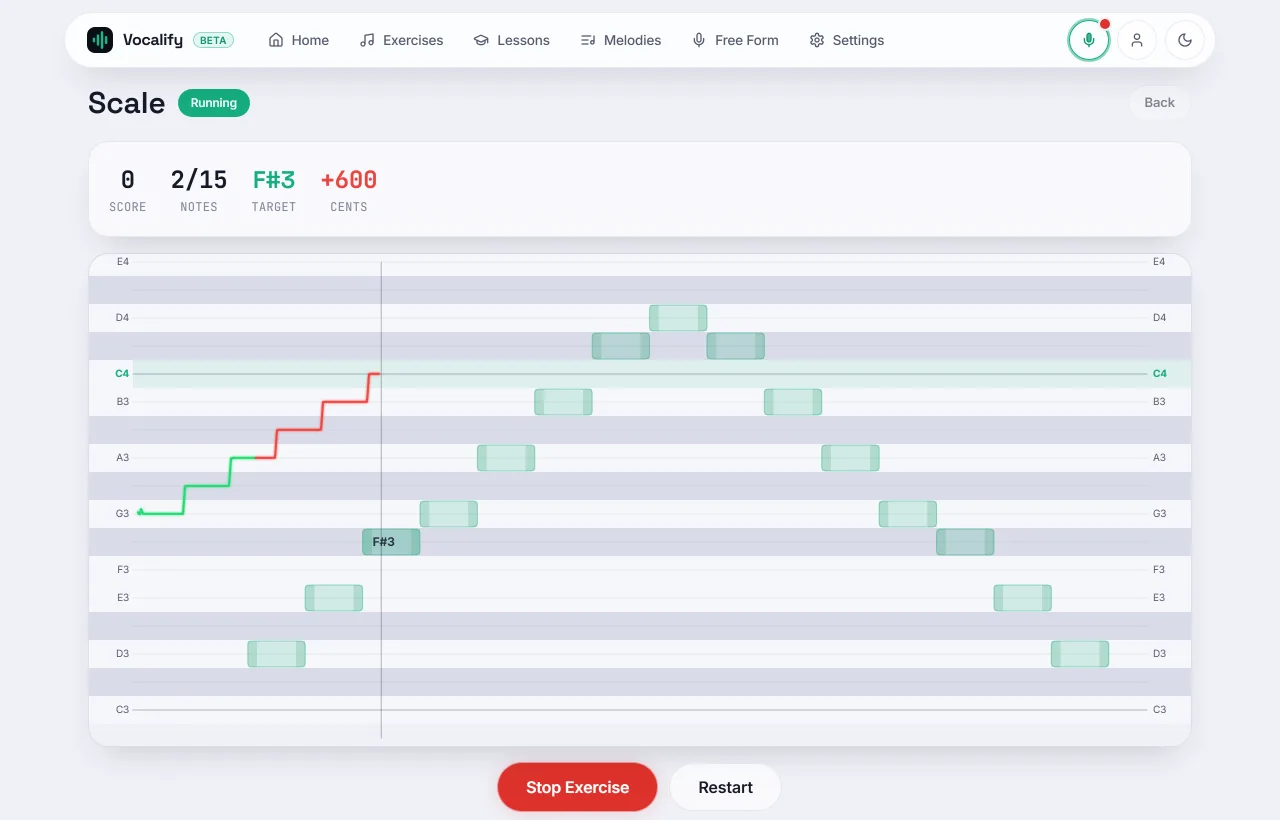
- They expose exactly where the problem is. Sung against a live pitch graph, the break shows up as a visible kink, jump or dropout — you find out precisely which semitone gives you trouble instead of guessing. That precise, immediate error signal is what motor learning actually runs on[2].
How to sing a siren
- Pick the sound. Start on a lip trill ("brrr") or an "ng" hum — both keep the larynx relaxed while you climb. Move to "oo", then an open "ah" only once the trill version is smooth.
- Start in the easy middle. Not at the bottom of your range. Begin where your voice is comfortable and secure.
- Slide up slowly. Take three or four seconds to sweep up. Slow is harder and much more useful than fast — speed hides the break.
- Come back down through the same path. The descent matters as much as the ascent; many voices are smooth going up and jump coming down.
- Stay quiet. Volume is not the goal, continuity is. If you get louder as you rise, you are pushing.
- Widen gradually. Start with a fifth. Once that is seamless, stretch to an octave, then beyond. Add range over weeks, not within one session.
The Glide exercise is built for this. It draws the target as a diagonal band and scores your pitch against the target as it moves, rather than against a fixed note — so a genuinely smooth sweep scores well and a jump across the break does not, even if you land the final note perfectly. The default preset is a siren (up, then back down). Add it to a Series to run it as the opening step of a saved warm-up.
Four variations worth knowing
- The classic siren. Up and back down in one breath, a fifth to an octave wide. Your default.
- One-way glides. Up only, or down only. Descending glides are underrated — they encourage a released, non-pushed top.
- The wide siren. As much of your range as you can manage smoothly, quietly, on a lip trill. Good for finding the true edges without loading them.
- Octave-and-back on a vowel. The hardest version, and the one closest to real singing. Save it for the end of a warm-up.
Common mistakes
- Going too fast. A quick swoop lets you skate over the break instead of training through it. Slow it down until you can feel the whole path.
- Getting louder as you climb. The most common fault. Aim for the same quiet volume top to bottom.
- Only sirening upward. Half the benefit is in the descent.
- Jumping instead of gliding. If your voice clicks over to a different register mid-sweep, you sang two notes, not a siren. Go quieter, narrower, and try again.
- Chasing the extremes on day one. A seamless fifth beats a ragged two octaves, every time.
FAQ
What is a siren exercise in singing?
A continuous glide of pitch — up, down, or both — sung without breaking the sound into separate notes. It is used to blend vocal registers, warm up, and extend range safely.
How often should I do sirens?
Daily is fine and ideal, because they are low-load. Two or three minutes at the start of every practice session is enough to see steady improvement over weeks.
Do sirens increase vocal range?
They help, and more safely than drilling high notes directly, because a siren passes through your top note while already in motion instead of sitting on it. Range growth is still gradual — semitones over months.
Why does my voice break during a siren?
You have found your passaggio, which is exactly the point of the exercise. Go quieter, slower, and narrower until you can cross it without the flip, then widen again from there.
References
- Titze, I. R. (2006). Voice training and therapy with a semi-occluded vocal tract: Rationale and scientific underpinnings. Journal of Speech, Language, and Hearing Research, 49(2), 448–459.
- Salmoni, A. W., Schmidt, R. A., & Walter, C. B. (1984). Knowledge of results and motor learning: A review and critical reappraisal. Psychological Bulletin, 95(3), 355–386.
Sing a siren and watch the line
The Glide exercise scores you against a moving target — free, no sign-up.
Open the Glide exercise