Can anyone learn to sing?
Yes. Setting aside the ~1.5% with true tone deafness[1], essentially anyone can learn to sing in tune — because singing is mostly a skill, not a fixed talent, and skills are built with practice and feedback. That includes adults starting from scratch.
Talent or skill?
Mostly skill. Some people start with a head start — a musical home, a good ear, an easy range — but the things that make singing sound good (accurate pitch, steady breath, a usable range, a trained ear) are all trained. Think of singing as a motor skill: you produce a sound, hear how far it landed from what you intended, and correct. Repeat that loop with clear feedback and you get better — the same way you'd learn any physical skill. What separates strong performers in skilled domains is overwhelmingly the amount and quality of focused practice, not an innate ceiling[3]. Talent sets a starting line, not a ceiling.
"But I really can't sing"
Most people who say this can hear pitch perfectly — they just haven't trained the production side. That gap is well documented: studies of inaccurate singers repeatedly find their pitch perception is normal[2]. The quickest way to prove it to yourself: take the tone-deaf test (you'll almost certainly pass), then read why you sing out of tune to see which fixable cause is yours.
Is it too late as an adult?
No. Adults keep the motor learning needed for pitch and breath control, and the hear-and-correct loop works at any age. Plenty of people learn to sing well for the first time in their 30s, 40s and beyond. The only real requirements are consistent practice and honest feedback — which is exactly what a live pitch display gives you.
How to start (this week)
- Rule out tone deafness with the quick test — for peace of mind.
- Find your range so practice fits your voice.
- Hold one steady note with live feedback until it sits centered.
- Add slow scales, a few minutes a day.
- Keep it daily and short. Consistency beats marathon sessions.
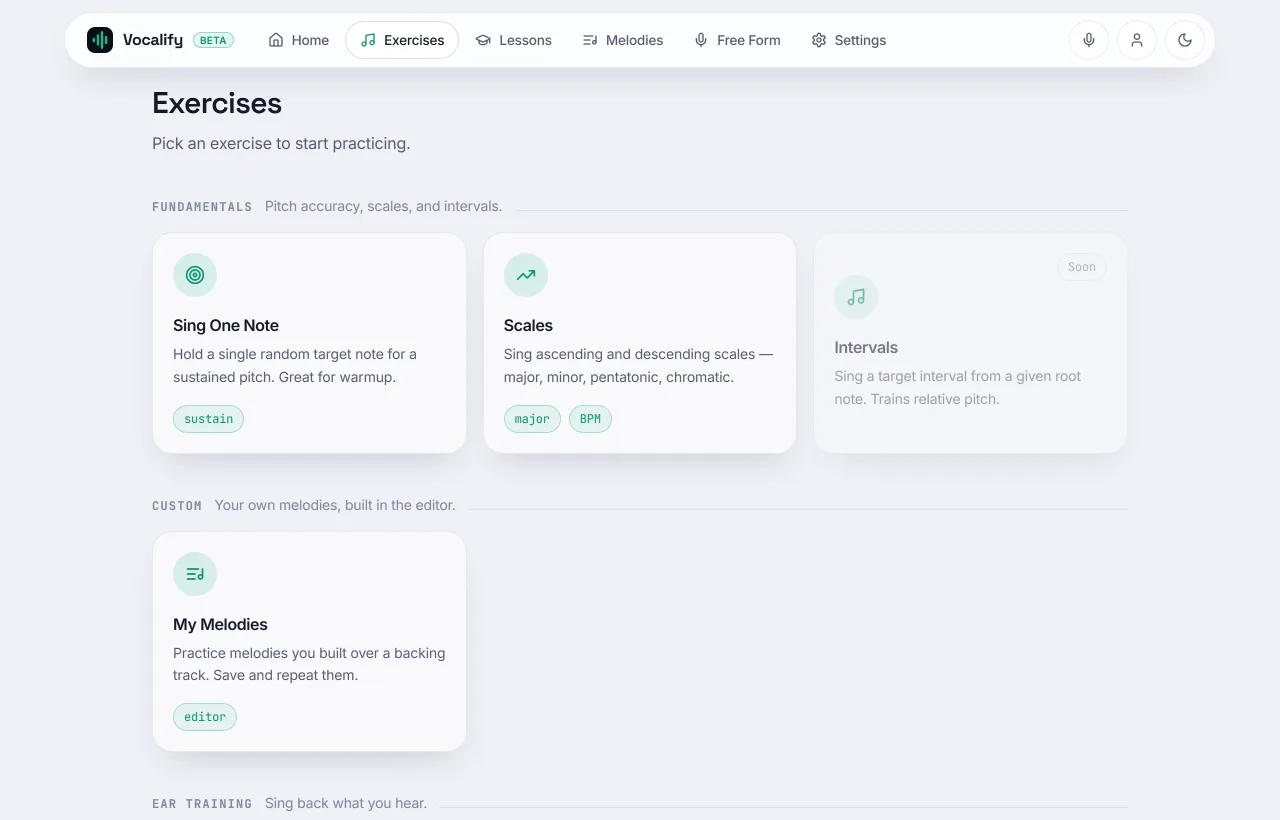
If you would rather not assemble that yourself, the same steps are already sequenced as beginner lessons inside a training plan that opens one at a time.
References
- Peretz, I., & Vuvan, D. T. (2017). Prevalence of congenital amusia. European Journal of Human Genetics, 25(5), 625–630.
- Pfordresher, P. Q., & Brown, S. (2007). Poor-pitch singing in the absence of "tone deafness". Music Perception, 25(2), 95–115.
- Ericsson, K. A., Krampe, R. T., & Tesch-Römer, C. (1993). The role of deliberate practice in the acquisition of expert performance. Psychological Review, 100(3), 363–406.
Prove it to yourself
Sing one note and watch it land in tune. Free, no sign-up, pitch detected in your browser.
Try it now