Am I tone deaf? Take the test
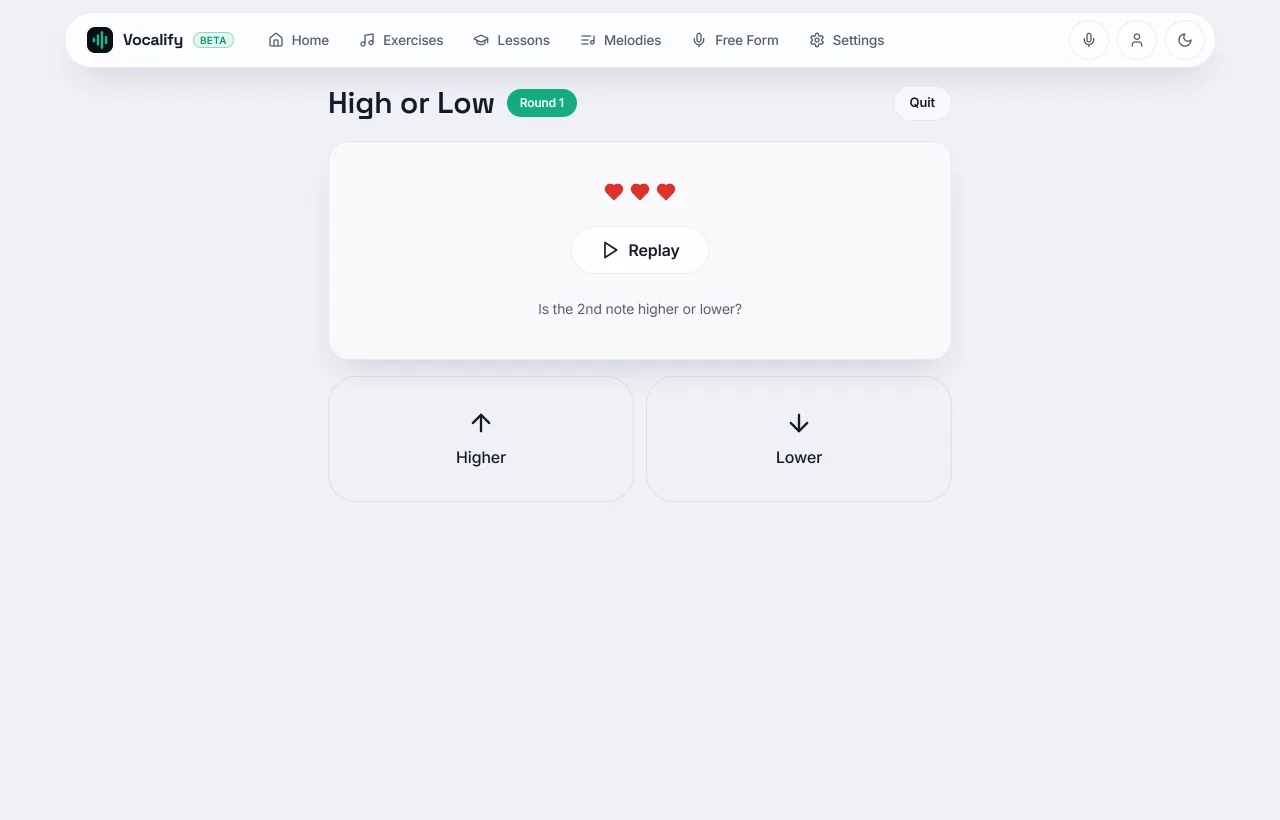
Take the test right here: hear two notes, tell which is higher. The gap shrinks as you go, finding the smallest pitch difference you can reliably hear. Spoiler: real tone deafness is rare — only about 1.5% of people — so this is usually a pleasant surprise. Free, in your browser.
- Question
- 0
- Gap
- —
Two notes play. Say whether the second one was higher or lower. Headphones help.
Was the second note higher or lower?
- Smallest gap you heard
- —
- Accuracy
- —
What "tone deaf" actually means
Most people who call themselves tone deaf are not. The clinical condition — congenital amusia — affects only around 1.5% of the population[1]. If you can tell a police siren from a doorbell, or notice when a singer clangs a wrong note, your pitch perception is almost certainly intact. What usually feels like tone deafness is an untrained ear or voice — and both are very trainable. Inaccurate singers, studied directly, usually turn out to perceive pitch perfectly well[2].
It's an adaptive staircase: the pitch gap gets smaller each time you answer correctly and larger when you miss, automatically settling at the finest difference you can hear. The result is a single number in cents (1 cent = 1/100 of a semitone) — the smaller, the sharper your ear.
Reading your result
- You hear big gaps easily — your pitch perception works. Any difficulty is about training, not a defect.
- You get down to small gaps (tens of cents or less) — that's a good, discriminating ear. It also improves with practice: trained listeners reach substantially finer thresholds than untrained ones[3].
- Everything sounds the same, even wide gaps — rare, and worth re-testing with good headphones in a quiet room before drawing conclusions.
Can you fix it?
If the test was hard, the fix is practice, not resignation. Pitch perception improves with feedback-rich ear training, and singing accuracy responds to real-time visual pitch feedback. The ear and the voice train together — sharpen one and the other follows.
Frequently asked
Is this a real diagnosis?
No — it's a quick screening for fun and motivation, not a clinical assessment of amusia.
Do I need headphones?
They help, especially for the smallest gaps. Use a quiet room for the fairest result.
Can tone-deaf people learn to sing?
Yes. The rare few with true amusia can often still improve, and the untrained majority improve a lot.
"I am tone deaf" — where should I actually start?
Take the test above before you accept the label. Most people who say it hear pitch differences perfectly well; what they can't yet do is aim their voice at what they hear. That's a motor skill, and it responds fast to seeing your pitch while you sing — start with the tuner and then how to sing in tune.
Tone deaf, or just singing out of tune?
Two different problems. Tone deafness is perception — you can't hear that two pitches differ. Singing out of tune is usually production — you hear the target fine, but your voice lands somewhere else. This test measures the first, so you stop guessing about the second. Why do I sing out of tune? covers the production side.
Why does my voice sound flat or toneless?
"Flat" gets used for two unrelated things: genuinely below pitch, and thin in timbre. If the test says your ear is fine, the usual culprits for a toneless sound are weak breath support and a closed, unresonant vowel — not your ear.
References
- Peretz, I., & Vuvan, D. T. (2017). Prevalence of congenital amusia. European Journal of Human Genetics, 25(5), 625–630.
- Pfordresher, P. Q., & Brown, S. (2007). Poor-pitch singing in the absence of "tone deafness". Music Perception, 25(2), 95–115.
- Micheyl, C., Delhommeau, K., Perrot, X., & Oxenham, A. J. (2006). Influence of musical and psychoacoustical training on pitch discrimination. Hearing Research, 219(1–2), 36–47.
Now train the ear you just measured
The app keeps every run, plays the test in your chosen instrument, and pairs it with interval drills and singing exercises.
Open the test in the app