Ear training for singers
Your voice can only be as accurate as your ear. The good news from decades of psychoacoustics: pitch perception is trainable. With feedback and repetition, people get measurably better at telling notes apart and naming the distance between them — and that sharper perception feeds straight back into singing in tune.
On this page
The ear is learnable
"Good ears" sound like a fixed trait, but the lab says otherwise. In controlled studies, listeners trained on pitch tasks improve substantially, and even non-musicians can reach near-musician performance on fine pitch discrimination after focused practice[1]. This is perceptual learning: repeated exposure with feedback tunes the auditory system to distinctions it used to miss.
For a singer, that matters because production rides on perception. You correct toward a target you can perceive; the finer your resolution, the smaller the errors you can catch and fix. Ear training and pitch training aren't separate hobbies — they're two ends of one loop. The link is not automatic, though: many inaccurate singers perceive pitch normally[4], which is why the production side needs its own feedback[3] rather than more listening alone.
Pitch discrimination: the foundation
The most basic aural skill is telling whether one note is higher or lower than another, and how small a difference you can still hear. Psychophysics has a proven tool for training and measuring exactly this: the adaptive staircase. The task gets harder each time you're right and easier each time you're wrong, so it automatically homes in on your current threshold and keeps you working right at the edge of your ability.
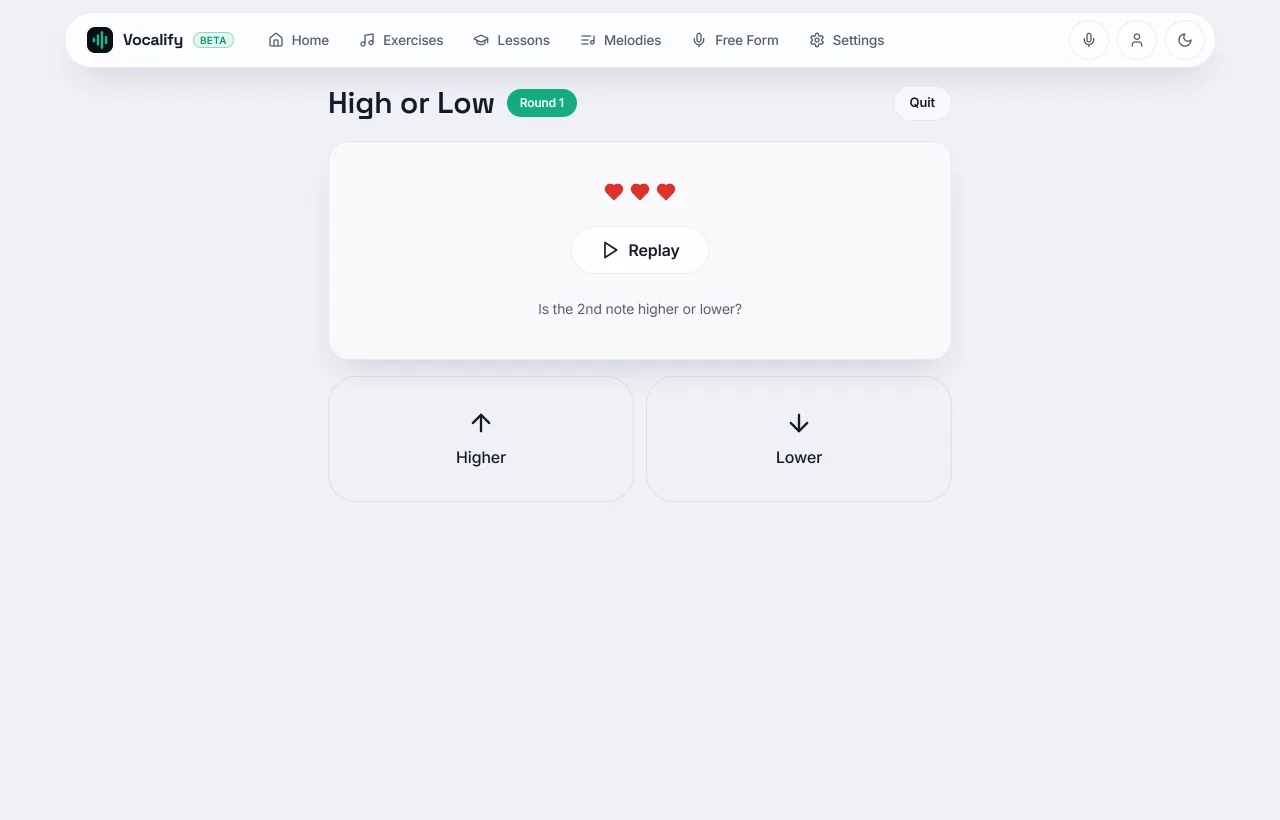
Practicing at a fixed, easy difficulty wastes reps; practicing at impossible difficulty just frustrates. An adaptive staircase keeps you near ~70–80% correct — the "desirable difficulty" zone where learning is fastest — and turns your smallest audible gap into a single number you can watch shrink.
Interval recognition: relative pitch
Melody is built from intervals — the distance between two pitches. Recognizing a major third or a perfect fifth by ear is the core of relative pitch, and unlike rare absolute pitch, it's a skill essentially anyone can build through practice and feedback. Naming intervals also gives you anchors: once "perfect fifth" is instant, you can pre-hear and target that leap when you sing.

Start with High or Low to sharpen raw resolution, then move to Interval Recognition to attach names to what you hear. Both are quiz-style — no singing required — so you can train your ear on a coffee break.
What makes ear training work
- Immediate feedback. Perceptual learning depends on knowing right away whether you were correct — the correction is the lesson[2].
- Adaptive difficulty. Stay near the edge of what you can do, not comfortably below it.
- Short, frequent sessions. Spacing practice across days consolidates aural skills better than massed cramming.
- Active retrieval. Answering (naming the interval, choosing higher/lower) beats passively listening — the testing effect applies to ears too.
- Connect it to your voice. After a quiz, sing the interval or note back so perception and production reinforce each other.
A routine that sticks
- 5 minutes, most days. One round of High or Low plus one set of Interval Recognition is plenty.
- Warm up your ear with easy intervals (octave, fifth) before the tricky ones (tritone, minor second).
- Track the number. Watch your smallest audible gap in cents fall, and your interval accuracy rise, over weeks.
- Alternate ear and voice days — or pair them — so the loop stays closed.
Two more ear modules are on the way: melodic dictation / sing-back — hear a short phrase and reproduce it, training auditory working memory — and chord-tone recognition, singing the root, third or fifth of a chord by ear. Both extend the same feedback-driven approach to richer musical material.
References
- Micheyl, C., Delhommeau, K., Perrot, X., & Oxenham, A. J. (2006). Influence of musical and psychoacoustical training on pitch discrimination. Hearing Research, 219(1–2), 36–47.
- Salmoni, A. W., Schmidt, R. A., & Walter, C. B. (1984). Knowledge of results and motor learning: A review and critical reappraisal. Psychological Bulletin, 95(3), 355–386.
- Hoppe, D., Sadakata, M., & Desain, P. (2006). Development of real-time visual feedback assistance in singing training: A review. Journal of Computer Assisted Learning, 22(4), 308–316.
- Pfordresher, P. Q., & Brown, S. (2007). Poor-pitch singing in the absence of "tone deafness". Music Perception, 25(2), 95–115.
Test your ear right now
How small a pitch difference can you hear? Find out in a minute.
Start High or Low