How to sing higher notes without straining
High notes don't need more force — they need steadier breath and a freer throat. Pushing harder is exactly what makes the top of your voice thin out and crack. Here's the safe way up: warm up, support, blend your registers, and climb one semitone at a time.
On this page
Why high notes strain
As you go up, two things tend to go wrong: you shove more air at the note, and you squeeze the throat to try to reach it. Both fight the mechanism. High pitches come from vocal folds that stretch and thin while the larynx stays free — a push and a squeeze do the opposite, so the note gets tight, sharp, or cracks. The fix isn't effort; it's coordination.
Support, don't push
"Support" means steady, controlled breath, not a hard blast. Airflow that stays even lets the folds do their job; a surge blows them apart and the tone breaks. Keep the throat open and relaxed — the feeling of a gentle yawn — and let the note float up on a consistent stream rather than a shove.
If a high note only appears when you tense up or get loud, it isn't yours yet. Back off a semitone, keep it easy and quiet, and build from there. Loud and strained is not "higher" — it's just louder.
Blend into head / mixed voice
Your voice has registers — roughly chest (thick, speech-like, low) and head (lighter, brighter, high) — with a transition zone (the passaggio) between them. Trying to drag heavy chest voice all the way up is the #1 cause of a strained ceiling. Instead, learn to lighten and blend into head or mixed voice as you rise, so the tone stays even instead of hitting a wall. See head voice vs chest voice for the full breakdown.
Climb the semitone ladder
The dependable way to add high notes is progressive overload: sing an easy five-note pattern where it's comfortable, then move it up a half step, then another — stopping the instant the tone strains. Over weeks the top of the ladder creeps higher. This is the same method in expanding your vocal range, aimed at the top.
- Warm up gently — humming and lip-trill glides before any high work.
- Find today's ceiling — the highest note that stays clean and easy.
- Ladder up a semitone on a light five-note scale, keeping the throat free.
- Stop at the first strain. That edge is today's win — don't force past it.
- Check it's in tune — a new high note that's sharp or flat isn't secured yet.
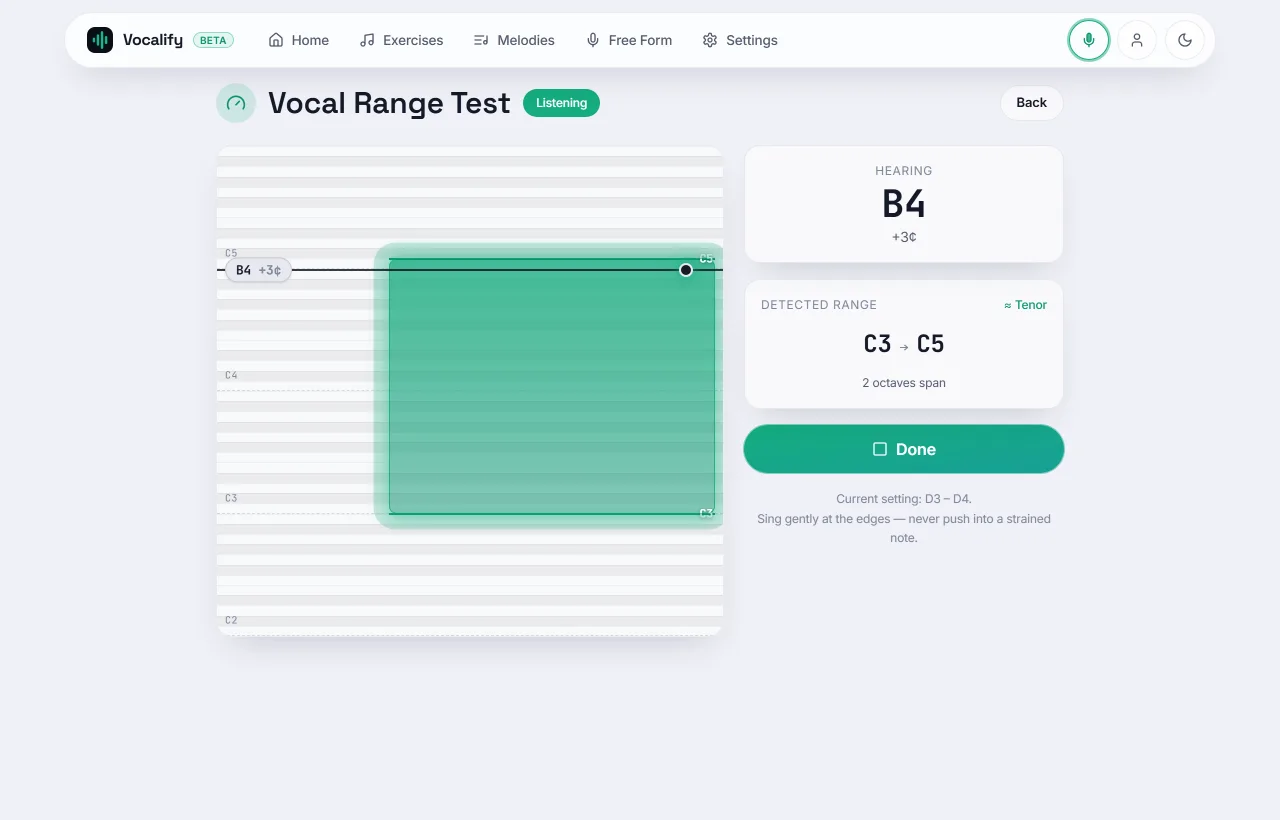
Map your top note in the vocal range test, then drill light ascending scales with the live pitch graph so each new high note lands centered, not just loud.
Sirens — smooth glides that sweep up through the passaggio and back down — are the single best exercise for a strain-free high range, because they carry one even tone across the break instead of asking you to "reach" for the top note. Run them in Vocalify's Glide exercise, which tracks your pitch against the moving target so you can see exactly where the sweep breaks up. Do them on a lip trill first — it keeps the larynx relaxed while you climb.
A practice routine
- Warm up first, every time — 3–5 min of humming and glides.
- Light and easy — practice high notes quietly before adding volume.
- Ladder up 2–3 semitones past comfort, stopping at strain.
- Short, frequent sessions beat one long push — the voice adapts with rest.
- Stop if it hurts. Pain or hoarseness means done for the day.
Find your top note, then push it
Map your range in a minute, then ladder up with live feedback.
Start the range test