Head voice vs chest voice (and mixed voice)
Most "I can't sing high" problems are really register problems. Learn what chest, head and mixed voice actually are, why your voice cracks at the passaggio, and how to blend the registers into one even tone from bottom to top.
On this page
What are vocal registers?
A register is a series of notes that share a similar production and feel. Simplified into the two most useful terms:
- Chest voice — thick, warm, speech-like. It's the register you talk in and the one that carries your lower notes. You feel the buzz in your chest.
- Head voice — lighter, brighter, higher. The vocal folds are thinner and more stretched, and the resonance feels like it's up in your head.
Both are healthy and useful. Great singing isn't about picking one — it's about moving between them without a seam.
The passaggio (the break)
Between chest and head sits a transition zone called the passaggio. It's where the coordination has to shift from thick-fold to thin-fold production. If nothing is trained there, the voice does the obvious thing at the handover: it cracks or suddenly flips into a weak, breathy head voice. That break isn't a defect — it's just an un-negotiated transition.
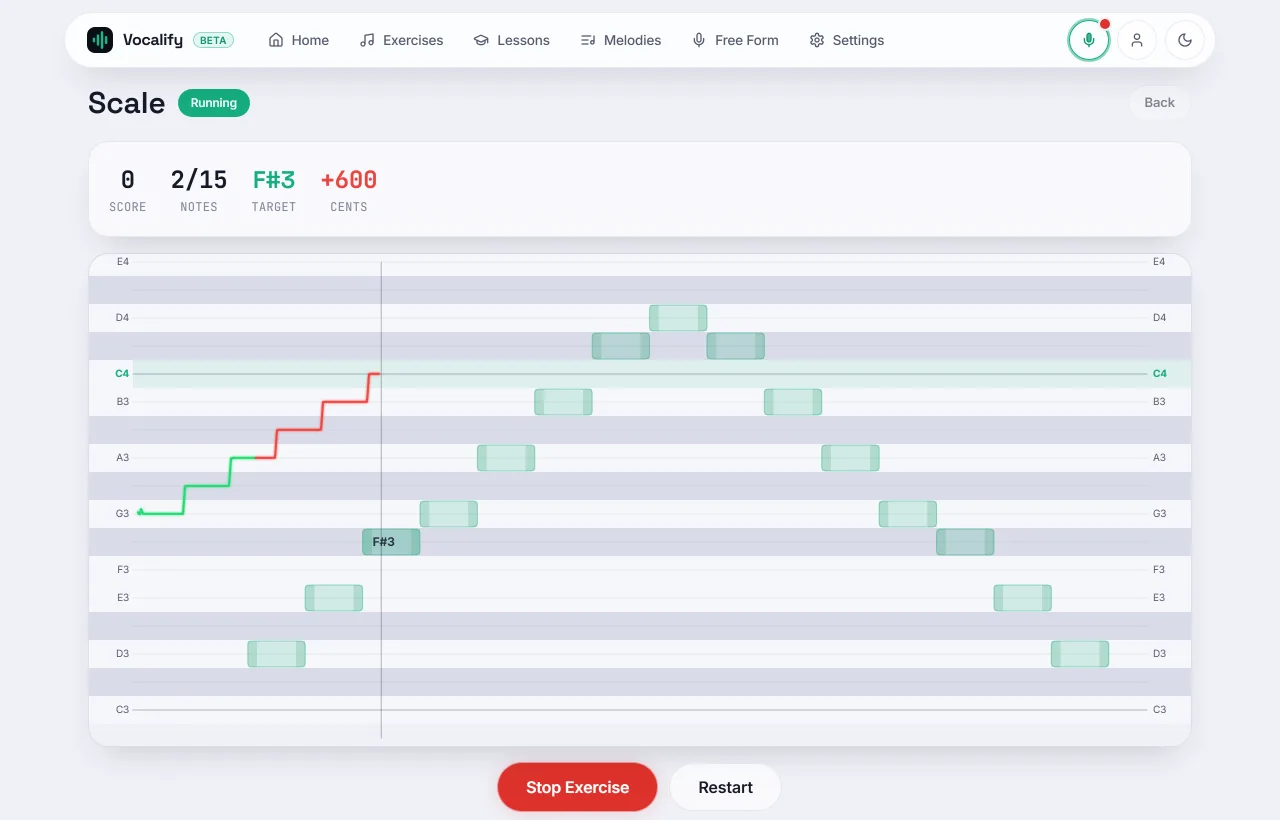
Mixed voice: the bridge
Mixed voice is exactly what it sounds like — a coordination that keeps some of chest voice's strength while adopting head voice's ease, so you cross the passaggio without a gear-change. It's not a magic third organ; it's a balance you train. A good mix is why some singers seem to belt effortlessly into their high range: they're not pulling chest up, they're blending.
How to blend your registers
- Glide slowly through the break. On an "ng" or a lip trill, slide from low to high and back, keeping the sound continuous — no sudden flip.
- Lighten as you rise. Don't carry full chest weight upward; let the tone thin a little through the passaggio so nothing jams.
- Keep breath steady, throat free. The same support that lets you sing higher is what smooths the blend.
- Use slow scales across the break. Repeat five-note patterns that sit right on your transition, aiming for an even tone with no bump.
- Watch it stay in tune. Cracks usually come with a pitch jump — keeping the line continuous and centered trains the blend.
Sing slow scales through your break and watch the pitch line on the graph, or explore freely in Tuner to see exactly where your voice jumps — then smooth it.
A siren — one continuous glide up and back down through the break — is the most direct register-blending exercise there is, because it never lets you "switch" registers: the pitch moves so smoothly that your voice has to find the middle ground. Vocalify's Glide exercise scores you against a moving target, so you can see whether you actually tracked the sweep or jumped across the passaggio. Lip trills and a hummed ng work best as the sound.
Common mistakes
- Pulling chest voice too high. The fast route to strain and a hard ceiling. Lighten and blend instead.
- Flipping to a weak, breathy head voice. Fine as a start, but train the mix so the top has strength.
- Forcing through the break. More air and squeeze makes cracks worse. Ease and glide.
- Avoiding the passaggio. You smooth a break by singing through it gently, not around it.
Hear — and see — your break
Sing a scale through your passaggio and watch the pitch line. Free, in your browser.
Try a scale